01
Connect or import the case
Start from the QMS, governed export, or controlled file path the quality team already uses. No day-one replacement is required.
QRI works beside the quality system you already use. It connects the evidence behind NCR, CAPA, 8D, supplier, and failure investigations; exposes contradictions and unsupported claims; and assembles a cited package for human review.
Investigation Assurance is the front door. The broader modular quality-management platform is included on the same governed foundation.
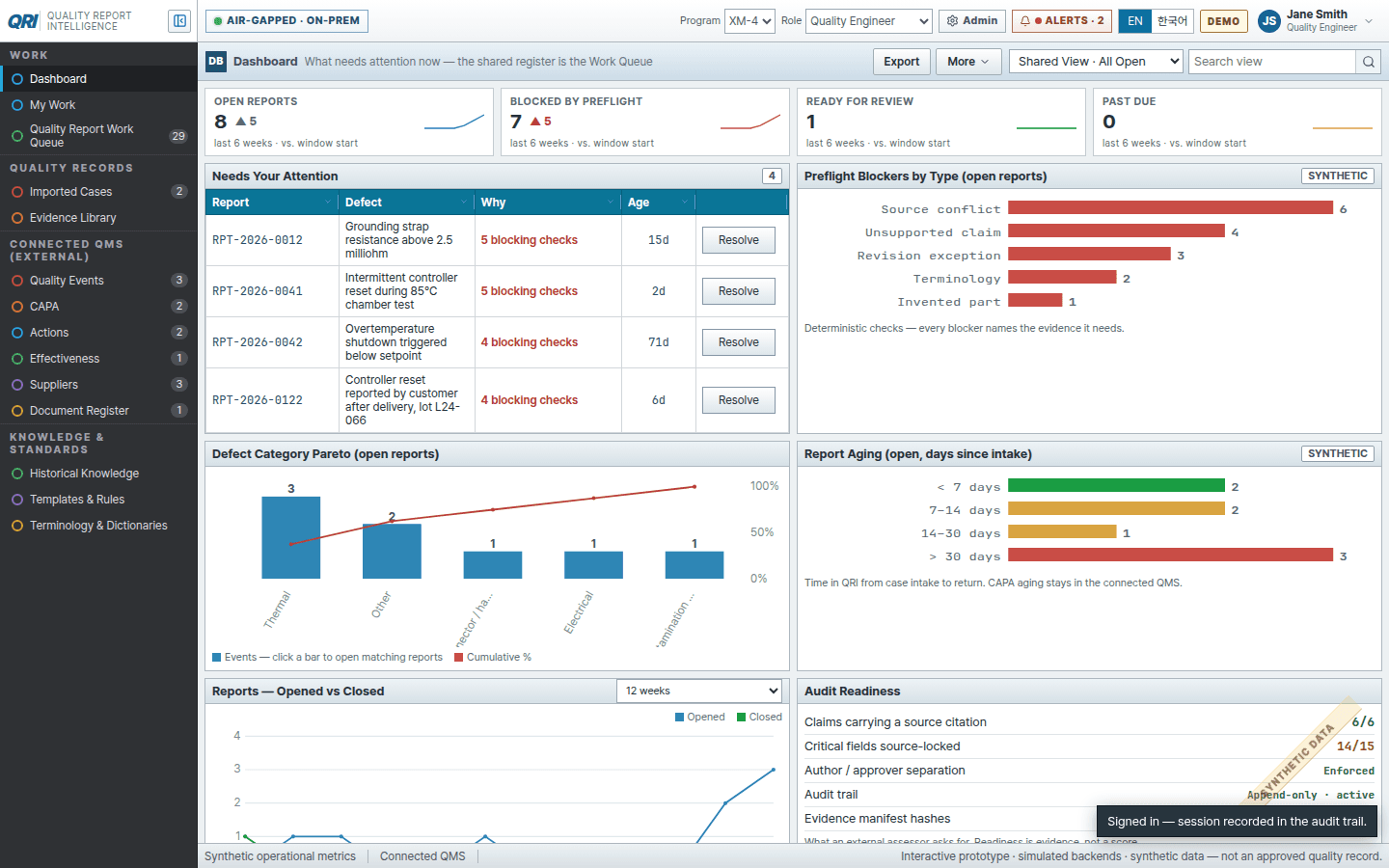
Quality evidence is usually distributed across the QMS, controlled documents, test logs, photos, supplier records, ERP or MES exports, spreadsheets, email, and previous investigations. QRI assembles the permitted context without pretending that every source is complete or correct.
Root-cause language that is not supported by governed evidence
Conflicting values across logs, worksheets, source systems, or revisions
Missing evidence that prevents a defensible conclusion
Stale controlled-document references and incomplete source lineage
Relevant historical cases and prior actions whose effectiveness later failed
Claims that should remain inconclusive or require another test
Start from the QMS, governed export, or controlled file path the quality team already uses. No day-one replacement is required.
Bring together the exact report, evidence, controlled document, supplier, action, effectiveness, and historical-case facts the investigator is authorized to use.
Separate what is known from what conflicts, what remains unsupported, and which prior cases are relevant or only superficially similar.
Produce a human-controlled brief or report draft whose material assertions link to governed evidence or remain visibly unsupported.
Use the controlled reviewer workflow and return the approved package to the incumbent QMS or governed export path.
These screens use synthetic demonstration data. Additional investigation, evidence, RCA, preflight, and reviewer views are shared only from the truthful release candidate used for the benchmark or pilot.
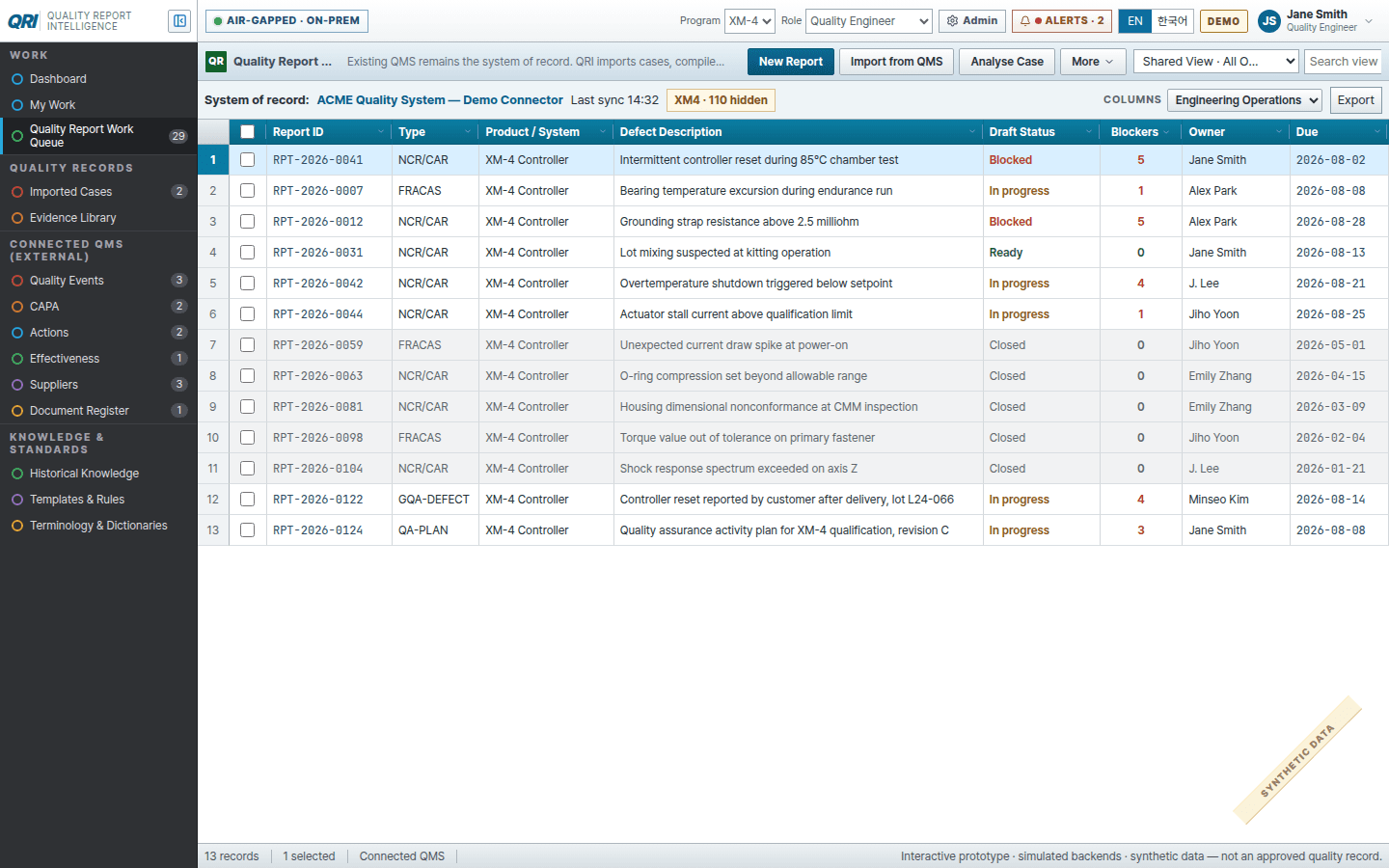
See assigned, blocked, review-ready, and returned investigation work without treating the browser as quality authority.
Track current work, blockers, downstream consequences, and connected-system state through one governed product surface.
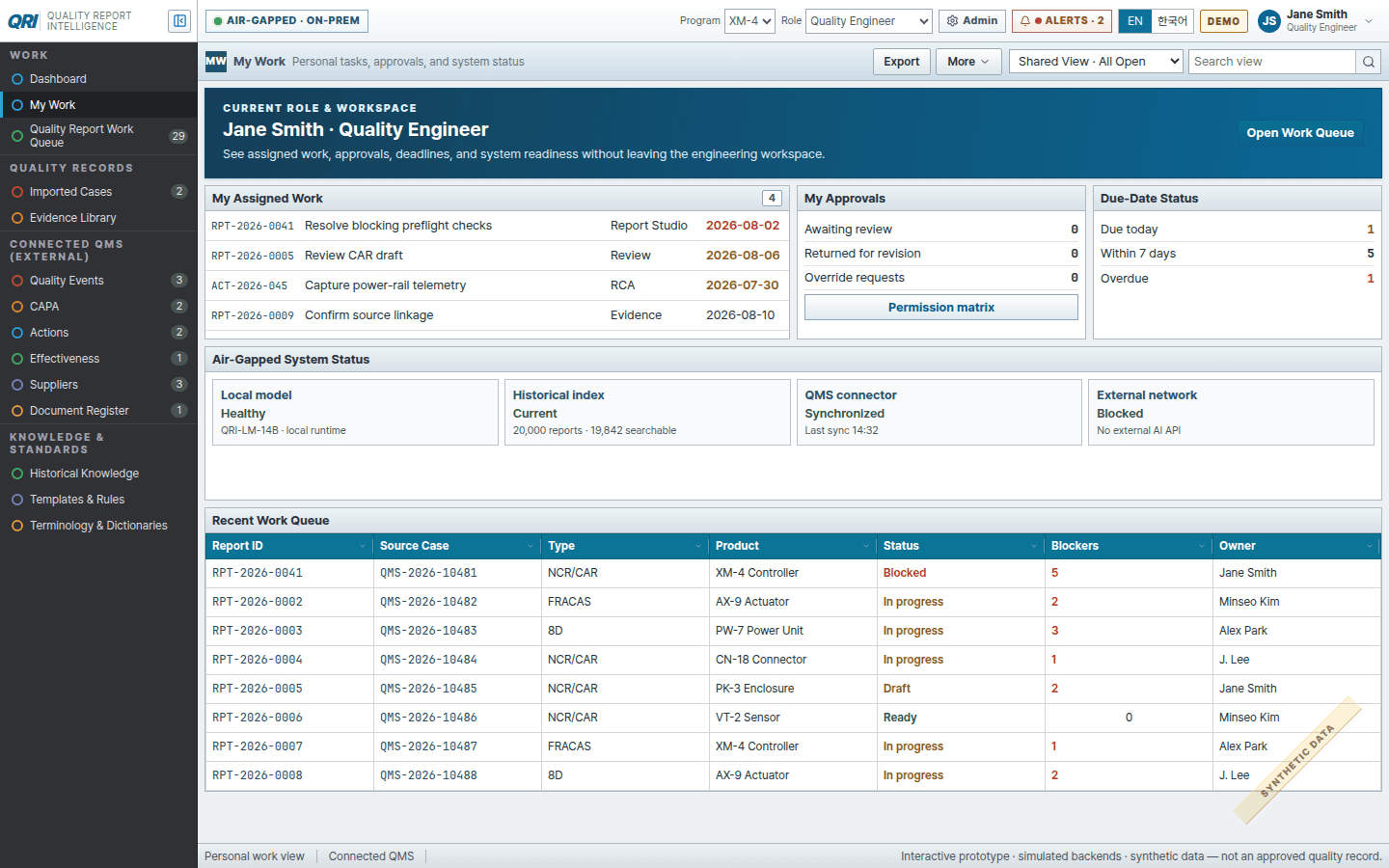
Investigators, reviewers, and administrators see the work and actions appropriate to their current authority and scope.
Quality Context is QRI’s closed, quality-specific model over exact versioned subjects and relationships. It supports the investigation outcome; it is not marketed as a generic ontology platform. Availability expands through separately accepted product slices.
Durable synchronization, mapping, source ownership, explicit unknown outcomes, writeback receipts, and reconciliation remain the integration plane.
Ordinary applications use versioned product contracts instead of direct database access or one-off browser automation.
A separately isolated read/proposal edge is qualification-gated for demonstrated enterprise-agent workflows. It is not the authority or synchronization plane.
PostgreSQL-backed QRI authority remains the controlled commit boundary. Connectors, providers, agents, and browser values remain untrusted inputs.
The current governed foundation and the qualification-gated Navigator roadmap are shown separately. Exact model-assisted capabilities depend on the accepted release, task policy, local model package, hardware profile, and customer operating profile.
Customers buy one QRI platform rather than a temporary investigation tool that must later be replaced. The exact support state remains visible while QRI progressively expands native authority across the corrective-quality loop and broader QMS workflows.
Import, author, preflight, review, approve, return, reconcile, and preserve exact history.
Governed evidence, exact citations, field provenance, historical comparisons, and human-disposed RCA proposals.
Create, assign, complete with evidence, and independently review corrective work.
Schedule, execute, review, preserve ineffective history, and return work to rework when required.
Preserve incumbent lineage today while the native corrective-quality loop expands on the same authority foundation.
Use exact controlled revisions and supplier lineage now, with native workflows planned as governed product slices.
Both entry points are paid, fixed-scope engagements. Neither requires a day-one global QMS replacement.
$10,000
Replay three to five completed investigations and measure evidence gathering, contradictions, unsupported claims, precedent retrieval, and the path to a cited review-ready brief.
$25,000
An eight-week, one-site engagement for a live or customer-controlled workflow under an explicitly agreed deployment, security, source-rights, validation, retention, and writeback boundary.
QRI is an investigation-first quality management platform. It connects the evidence behind NCR, CAPA, 8D, supplier, and failure investigations, exposes conflicts and unsupported claims, and produces a cited package for human review.
Not on day one. QRI can operate beside an existing QMS, preserve source ownership, and return an approved package. Customers can progressively operate supported workflows natively in QRI when they are ready.
Quality Context is QRI’s quality-specific operating model over exact source cases, reports, facts, evidence, document revisions, suppliers, actions, effectiveness checks, and their governed relationships. It is supporting product architecture, not a generic ontology product.
QRI is designed for a separately isolated, permission-filtered MCP access edge for read and proposal workflows after the exact customer workflow and security profile are qualified. MCP does not replace connectors, query PostgreSQL directly, or expose model-controlled approval, closure, waiver, effectiveness acceptance, or external dispatch.
QRI is designed for customer-local and disconnected deployment under exact qualified operating profiles. The supported operating system, database, ingress, identity, storage, model, backup, and writeback boundaries are stated for each deployment rather than implied broadly.
No. QRI does not certify a customer, and it does not claim that a model can determine the true root cause. It helps teams assemble evidence, preserve provenance, expose uncertainty, and complete their own controlled review and approval process.
Bring a completed, de-identified investigation and the evidence your team actually used. We will tell you honestly whether QRI can create a useful, defensible benchmark within the fixed scope.